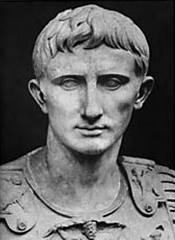
An article talking about how our president has become more aggressive using executive powers to pass laws.
http://www.msnbc.msn.com/id/47138446
 |
| Consul Barrackus Obamicus |
WASHINGTON — One
Saturday last fall, President Obama interrupted a White House strategy meeting
to raise an issue not on the agenda. He declared, aides recalled, that the
administration needed to more aggressively use executive power to govern in the
face of Congressional obstructionism. (Read
that the congress that was voted in to curb Obamas’ legislative plans, and for
the most part doing a terrible job at it, are frustrating him. Somehow I feel
our constitution will not fare well in the next couple of paragraphs).
“We had been attempting to highlight the
inability of Congress to do anything (If
only. The only time things are going
well is when it seems that nothing gets done.
Remember the critically important, i.e. manufactured, debt crisis? A
beautiful period were congress was too busy scare mongering to pass any more
terrible laws.” recalled William M. Daley, who was the White House chief of
staff at the time. “The president expressed frustration, saying we have got to
scour everything and push the envelope in finding things we can do on our own.”
(In plain English, how can we twist or
bend the constitution that allows us to rule more and more by decree so we can
get what we want passed.)
For
Mr. Obama, that meeting was a turning point. As a senator and presidential
candidate, he had criticized George W. Bush for flouting the role of Congress.
And during his first two years in the White House, when Democrats controlled
Congress, Mr. Obama largely worked through the legislative process to achieve
his domestic policy goals (It isn’t hard
to do that when you had a super majority, something which rarely ever happens.
It is also telling that the article neglects to mention what was worked
through, because by and large nothing was done.
The democrats have the dubious honor of having a once in a century occurrence,
a filibuster proof majority, and they couldn’t get anything done; thankfully.)
But
increasingly in recent months, the administration has been seeking ways to act
without Congress. Branding its unilateral efforts “We Can’t Wait,” a slogan
that aides said Mr. Obama coined at that strategy meeting, the White House has
rolled out dozens of new(doomed to fail)
policies — on creating jobs for veterans (good
luck. The free market would do a better job), preventing drug shortages (were in the constitution is it the federal
government’s responsibility to make sure people who are on pills can get them?),
raising fuel economy standards (Didn’t
he already do this?), curbing domestic violence (Not to disparage those who suffer from domestic violence but this has
been a perennial problem as far as I can remember. Generally when ‘issues’ are
perennial problems the problem is manufactured.
The fact is, despite what femnazis would have you believe, there aren’t
a whole lot of men, let’s not pretend that this would be a gender neutral issue
shall we, going around and beating women) and more.
Each
time, Mr. Obama has emphasized the fact that he is bypassing lawmakers. When he
announced a cut in refinancing fees for federally insured mortgages last month (Because that will accomplish so much for
those that have mortgages that are tens or hundreds of thousands of dollars
underwater), for example, he said: “If Congress refuses to act, I’ve said
that I’ll continue to do everything in my power to act without them.”
Aides
say many more such moves are coming. Not just a short-term shift in governing
style and a re-election strategy, Mr. Obama’s increasingly assertive use of
executive action could foreshadow pitched battles over the separation of powers
in his second term, should he win and Republicans consolidate their power in
Congress.
Many
conservatives have denounced Mr. Obama’s new approach. (But are secretly want to have a conservative, and I use that term
loosely, president who will do the same.) But William G. Howell, a
University of Chicago political science professor and author of “Power Without
Persuasion: The Politics of Direct Presidential Action,” said Mr. Obama’s use
of executive power to advance domestic policies that could not pass Congress
was not new historically. Still, he said, because of Mr. Obama’s past as a
critic of executive unilateralism, his transformation is remarkable. (This is only news if you took what he was
saying at face value; those that have the ability to read between the lines or
look at what he pushed for in the past.
Words only have meaning from corresponding action. If a person with a history of pushing
creationism in public schools started talking about the need to keep political
agendas out of the class room you wouldn’t take him seriously way. So why would you take a president, whose
previous legislative, however bare, and private correspondence indicated a man
who would govern very differently from what he promised, seriously?)
“What is surprising is that he is coming
around to responding to the incentives that are built into the institution of
the presidency (No they weren’t. These
are all relatively recent phenomena that we take as truth. The presidency was designed to be weak
domestically and strong internationally.
In determining the laws of the nation he would have little power, but in
enforcement and defense he would have the power required.),” Mr. Howell
said. “Even someone who has studied the Constitution and holds it in high
regard (Who in this country says they
don’t? I have never ever heard anyone
say anything negative about our constitution.
But I hear people all the time, the president included, advocate
policies that are in direct violation of a pretty plainly worded document.) —
he, too, is going to exercise these unilateral powers because his long-term
legacy and his standing in the polls crucially depend upon action.”
Mr.
Obama has issued signing statements claiming a right to bypass a handful of
constraints — rejecting as unconstitutional Congress’s attempt to prevent him
from having White House “czars” on certain issues, for example(I could be wrong but I cannot think of
anything in the constitution that prohibits the congress from doing this. The constitutional
never directly stated there were to be cabinet members, nor did it prohibit the
president from appoint members to cabinet positions to help him execute his
role as chief executive for each. What disturbing is the number of czars Obama
has had, which is equal to the number of czars every president from FDR had
till now, excluding our previous president who also had predilection for
appointing czars. Obama has 38 according
to this
chart, more than three times the amount of FDR! Even more absurd is that we
have an AIDS czar). But for the most part, Mr. Obama’s increased
unilateralism in domestic policy has relied on a different form of executive
power than the sort that had led to heated debates during his predecessor’s
administration: Mr. Bush’s frequent assertion of a right to override statutes
on matters like surveillance and torture.
“Obama’s
not saying he has the right to defy a Congressional statute,” said Richard H.
Pildes, a New York University law professor. “But if the legislative path is
blocked and he otherwise has the legal authority to issue an executive order on
an issue, they are clearly much more willing to do that now than two years
ago.” (Because of the Republican wave
last election cycle.)
The
Obama administration started down this path soon after Republicans took over
the House of Representatives last year.
(This begs the question. Was the
President ever going to try and work with the Republican majority?) In
February 2011, Mr. Obama directed the Justice Department to stop defending the
Defense of Marriage Act, which bars federal recognition of same-sex marriages,
against constitutional challenges. Previously, the administration had urged
lawmakers to repeal it, but had defended their right to enact it.
In
the following months, the administration increased efforts to curb greenhouse
gas emissions through environmental regulations, gave states waivers from
federal mandates if they agreed to education overhauls (Because all previous federal government directives for education were
stellar success), and refocused deportation policy in a way that in effect
granted relief to some illegal immigrants brought to the country as children.
Each step substituted for a faltered legislative proposal.
But
those moves were isolated and cut against the administration’s broader
political messaging strategy at the time: that Mr. Obama was trying to reach
across the aisle to get things done (And
so did Bush, and Clinton, and Reagan and so on and so forth.). It was only
after the summer, when negotiations over a deficit reduction deal broke down
and House Republicans nearly failed to raise the nation’s borrowing limit (i.e. the republicans reneged on their
promise to those who elected them. Ensuring that greater economic and fiscal
damage will come later rather than deal with it now.), that Mr. Obama fully
shifted course.
First,
he proposed a jobs package and gave speeches urging lawmakers to “pass this
bill” — knowing they would not. A few weeks later, at the policy and campaign
strategy meeting in the White House’s Roosevelt Room, the president told aides
that highlighting Congressional gridlock was not enough.
“He
wanted to continue down the path of being bold with Congress and flexing our
muscle a little bit, and showing a contrast to the American people of a
Congress that was completely stuck,” said Nancy-Ann DeParle, a deputy chief of
staff assigned to lead the effort to come up with ideas.
Ms.
DeParle met twice a week with members of the domestic policy council to
brainstorm. She met with cabinet secretaries in the fall, and again in February
with their chiefs of staff. No one opposed doing more; the challenge was coming
up with workable ideas, aides said.
The
focus, said Dan Pfeiffer, the White House communications director, was “what we
could do on our own to help the economy in areas Congress was failing to act,”
so the list was not necessarily the highest priority actions, but instead steps
that did not require legislation.
Republican
lawmakers watched warily. One of Mr. Obama’s first “We Can’t Wait”
announcements was the moving up of plans to ease terms on student loans (As a recent graduate myself I can
sympathize. A generation of individuals has been suckered into believing that
taking out $ 40,000 for a bachelors' in pottery making was the ticket to
financial wellbeing. But ultimately this won’t help. If we really want to
address this issue then we should let student loans be discharged through
bankruptcy.) . After Republican complaints that the executive branch had no
authority to change the timing, it appeared to back off.
The
sharpest legal criticism, however, came in January after Mr. Obama bypassed the
Senate confirmation process to install four officials using his recess
appointment powers, even though House Republicans had been forcing the Senate
to hold “pro forma” sessions through its winter break to block such
appointments.
Mr.
Obama declared the sessions a sham, saying the Senate was really in the midst
of a lengthy recess. His appointments are facing a legal challenge, and some
liberals and many conservatives have warned that he set a dangerous precedent.
Senator
Harry Reid of Nevada, the Senate Democratic leader, who essentially invented
the pro forma session tactic late in Mr. Bush’s presidency, has not objected,
however. Senate aides said Mr. Reid had told the White House that he would not
oppose such appointments based on a memorandum from his counsel, Serena Hoy.
She concluded that the longer the tactic went unchallenged, the harder it would
be for any president to make recess appointments — a significant shift in the
historic balance of power between the branches.
The
White House counsel, Kathryn Ruemmler, said the Obama administration’s legal
team had begun examining the issue in early 2011 — including an internal Bush
administration memo criticizing the notion that such sessions could block a
president’s recess powers — and “seriously considered” making some appointments
during Congress’s August break. But Mr. Obama decided to move ahead in January
2012, including installing Richard Cordray to head the new consumer financial
protection bureau, after Senate Republicans blocked a confirmation vote.
“I
refuse to take ‘no’ for an answer,” Mr. Obama declared, beneath a “We Can’t
Wait” banner. “When Congress refuses to act and — as a result — hurts our
economy and puts people at risk, I have an obligation as president to do what I
can without them.”
The
unilateralist strategy carries political risks. Mr. Obama cannot blame the
Republicans when he adopts policies that liberals oppose, like when he
overruled the Environmental Protection Agency’s proposal to strengthen antismog
rules (Good) or decided not to sign
an order banning discrimination by federal contractors based on sexual
orientation.
The
approach also exposes Mr. Obama to accusations that he is concentrating too
much power in the White House. Earlier this year, Senator Charles E. Grassley,
Republican of Iowa, delivered a series of floor speeches accusing Mr. Obama of
acting “more and more like a king that the Constitution was designed to
replace” and imploring colleagues of both parties to push back against his
“power grabs.” (Very true Senator, but
were you saying the same things about a previous strong executive?)
But
Democratic lawmakers have been largely quiet; many of them accuse Republicans
of engaging in an unprecedented level of obstructionism and say that Mr. Obama
has to do what he can to make the government work. (A few years ago we could have switched the parties) The pattern adds to a bipartisan history in
which lawmakers from presidents’ own parties have tended not to object to
invocations of executive power.
For
their part, Republicans appear to have largely acquiesced. Mr. Grassley said in
an interview that his colleagues were reluctant to block even more bills and
nominations in response to Mr. Obama’s “chutzpah,” lest they play into his
effort to portray them as making Congress dysfunctional. (The Republicans could also be thinking that being too aggressive at
this point in an election cycle could snatch defeat from the jaws of victory.)
“Some
of the most conservative people in our caucus would adamantly disagree with
what Obama did on recess appointments, but they said it’s not a winner for us,”
he said. (Unfortunately he is right)
Mr.
Obama’s new approach puts him in the company of his recent predecessors. Mr.
Bush, for example, failed to persuade Congress to pass a bill allowing
religiously affiliated groups to receive taxpayer grants — and then issued an
executive order making the change.
President
Bill Clinton increased White House involvement in agency rule making, using
regulations and executive orders to show that he was getting things done
despite opposition from a Republican Congress on matters like land
conservation, gun control, tobacco advertising and treaties. (He was assisted
by a White House lawyer, Elena Kagan, who later won tenure at Harvard based on
scholarship analyzing such efforts and who is now on the Supreme Court.)
And
both the Reagan and George Bush administrations increased their control over
executive agencies to advance a deregulatory agenda, despite opposition from
Democratic lawmakers, while also developing legal theories and tactics to increase
executive power, like issuing signing statements more frequently.
The
bipartisan history of executive aggrandizement in recent decades complicates
Republican criticism. In February, two conservative advocacy groups —
Crossroads GPS and the American Action Network — sponsored a symposium to
discuss what they called “the unprecedented expansion of executive power during
the past three years.” It reached an awkward moment during a talk with a former
attorney general, Edwin Meese III, and a former White House counsel, C. Boyden
Gray.
“It’s
kind of ironic you have Boyden and me here because when we were with the
executive branch, we were probably the principal proponents of executive power
under President Reagan and then President George H. W. Bush,” Mr. Meese said,
quickly adding that the presidential prerogatives they sought to protect,
unlike Mr. Obama’s, were valid. (Glad to
know some of our betters have a sense of irony)
But
Jack L. Goldsmith, a Harvard law professor who led the Justice Department’s
Office of Legal Counsel during the George W. Bush administration, said the
Obama administration’s pattern reflects how presidents usually behave,
especially during divided government, and appears aggressive only in comparison
to Mr. Obama’s having been “really skittish for the first two years” about
executive power.
“This
is what presidents do,” Mr. Goldsmith said. “It’s taken Obama two years to get
there, but this has happened throughout history. You can’t be in that office
with all its enormous responsibilities — when things don’t happen, you get
blamed for it — and not exercise all the powers that have accrued to it over time.”
(Fair enough, it isn’t as
if Obama isn’t doing anything that previous president hadn’t done, but therein
lies the problem. Neither Obama, Bush,
nor any president wants to do harm to this country, or even the
constitution. But we have allowed
dangerous ideas; like that the
constitution is a living document or is open to ‘interpretation’ as well as the
need to have a very strong president, proliferate and infect our system. A little over a hundred years ago we had a
democratic president resisting calls to try and enact government involvement
into people’s lives and into the economy. Today we are lucky if we can get a
republican presidential candidate, excepting Ron Paul of course, who can even
accurately describe how a free market or society is supposed to work. And that is the responsibility that falls
upon us citizens. We must undo a
centuries worth of damage. We need to reroute,
reinforce, and relay the bricks of freedom that make the foundation for our
city upon the hill.)
Always
and humbly yours
Cogitans
Iuvenis