One thing that I cannot make all too clear is that either secession from, or partitioning of, America would be a catastrophic event with few, in my opinion no, upsides. The United States is a continental entity, much like the Roman Empire was two thousands years ago, and the dissolution of the union would have catastrophic consequences for the continent. If the United States fragmented into numerous polities it would have the effect of Europanizing then continent.

Here is the Roman Empire at its height between the 2nd and 3rd centuries. No fewer than two dozen nations were either entirely, or partially, encompassed in the most powerful, and prosperous, polity the western world had ever seen. Now, the Western Roman Empire's demise is hard to actually pinpoint, we pick 476 AD for the sake of convenience, but documents can be found as late as the 6th century referring to the Western Roman Empire, and you could make a case that the empire had effectively ceased once the two were split between east and west. But to avoid making things too difficult let us go with the date of 476 AD as the date that Rome ceased to be. Here is a map of Europe not even 200 years after the fall.

As you can see, Europe is now a series of feuding petty kingdoms, each fighting for the scrapes of what remains of the riches of a once great empire. One thing that you will learn if you ever become a student of realpolitik is that nations are either, formed from a group of homogeneous individual or, by geographic boundaries.
Stable nations will have a large homogeneous population and borders anchored to geographic regions that help protect their integrity. If one of those conditions is not met then instability can, though as the US and Canada have shown not always, ensue. Nations will act to counter that instability either by changing their demographics or expanding their borders.
If you look at this link and move through the centuries. You will notice that many 'nations' didn't achieve borders similar to their modern ones for almost 500 to 800 years after the 'fall' of Rome, for England, Portugal, Spain, Scotland, and France. And that the to and fro of adjusting borders didn't cease until the modern age. Hundreds, if not thousands, of wars were fought, countless millions of lives lost, and to this day the geographic fallout of the fall of Rome haven't fully ceased, just look at the conflicts in the Balkans.
If the US collapses, how would the American continent end up being any different from Europe? The simple, and correct, answer is that there is no indication that this wouldn't happen. I invite you to look back at the map of the Roman Empire at its height, were the provincial boundaries are shown in dark red lines, and you will notice, that outside of Italy, that there isn't a provincial boundary that confirms to the boarders of a modern state.
The reason for this is that administrative boundaries are created for entirely different reason than national ones. An administrator may want to draw boundaries that will create a province, state, or dominion that will have a variety of resources, e.g the American states, or that will help prevent a base of people from successfully rebelling, e.g Rome. Or if you want a modern day example just look at the European partitioning of Africa. How stable are those nations now that the European powers are no longer there? Not very. If the United States collapses, or even if states secede, there is no guarantee that the boundaries you see now while the states are administrative entities within a nation are the same ones you would see after secession or collapse. Assuming that we had a partition along political lines, red versus blue, if you look at the election results by county you will see just how different the political environment is within states.
But even ignoring that just look a the geographic map of the United States with an overlay of the states boundaries.
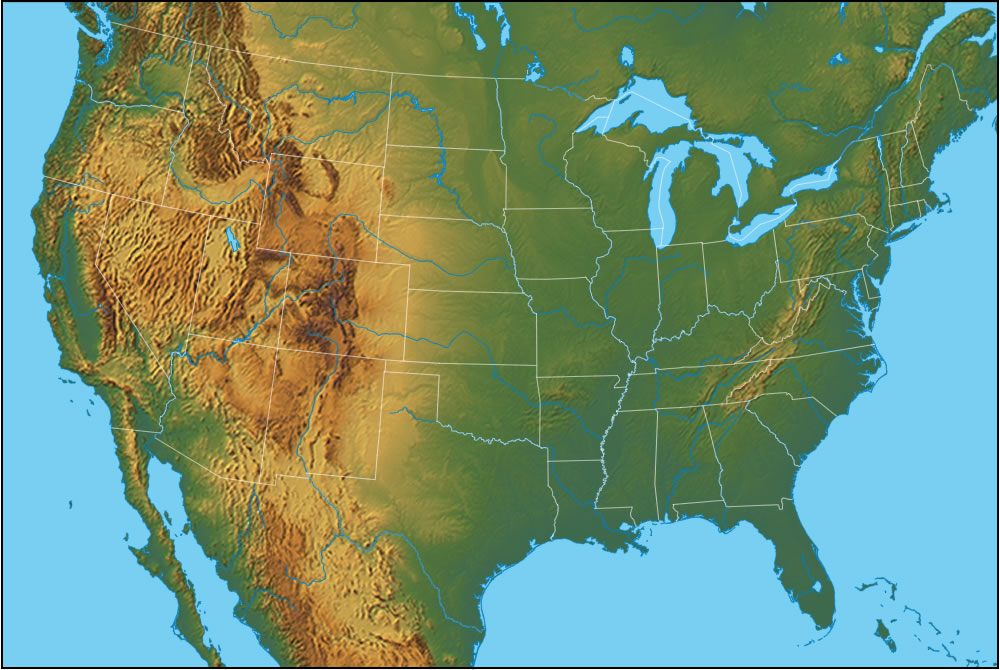
There are many states, particularly west of Mississippi that have boundaries that are either all, or in part, that are not anchored by any major geographic feature. This is a great source of instability, and if you don't believe me then read about the Northern European plain, which is one of the reasons why Germany wanted to annex parts of Poland. National polities will try to anchor themselves with boarders that help protect their integrity.
We now have to consider the role demographics plays in all this. Here is a map showing the largest demographic in each given county:

Green is obviously caucasian, orange hispanic, blue african, and purple tribal. The way the coloring works is that the largest racial group, it could be a plurality, is colored and the darker the color the higher percentage of the county is made up of that race.
Non Hispanic Caucasian

Hispanic Caucasian

African

Asian

Now I am not a race realist, however, I won't dismiss things out of hand just because I don't agree with it. I am a culture realist, and I do believe that some cultures are better than other and that this idea of a multicultural nation, where all cultures are considered equal, is fundamentally unstable. The US has historically done a tremendous job integrating culturally different individual into the dominant culture of the United States. But the last few decades the intellectual, political, and even cultural leaders of our country have turned against the melting pot concept and forwarded a salad bowl idea.
This idea is inherently destabilizing. Once again I must stress this is not a racial idea, but a cultural one, remember that Hispanics are racially Caucasian And eventually the democrats will find that their minority party will fracture as different groups will have different ideas. Catholics used to overwhelmingly vote for the democrats, and now vote for the republicans. Blacks used to vote for republicans, and now they vote for democrats.
I don't think you'll find many individuals. if they are honest, that won't admit that the US will probably experience some cultural, ethnic, and racial tension. The US has had at least a dozen major racial riots since 1980.
Video 1
Video 2
The fact that a vast majority of people in this country don't want to harm anyone, regardless of their race, doesn't matter. There are a few individuals that do hate others based off of skin color, or ethnicity, and would commit grievous bodily harm, or worse, if the opportunity arose. And that is all it take to set off a spiraling cycle of violence because I promise you the Caucasian/Asian/Hispanic/African person that is pulled from their care and beaten by a Caucasian/Asian/Hispanic/African mob will forever distrust, and probably hate, Caucasian/Asian/Hispanic/Africa people because of what happened to them. That is how system infighting and violence start. It wasn't as if the Irish Catholics and Protestants, or the Sunni and Shia decided one day that they would enjoy killing each other. If racial tensions got bad enough that difference racial groups tried to cleanse their homes of different races, and history is full of these types of instances, then what will happen in an area like San Francisco?

There are those who argue that partitioning of the US or secession could be done peacefully,via democratic means, much like Canada, Australia, and New Zealand leaving the Dominion of Great Britain. But examples of these are few and far between.
Brazil: Two states seceded from Brazil in 1835 which resulted in the War of the Farrapos the ended in Brazil putting down the rebellion.
Federal Republic of Central America: A union of the modern day Latin republics of Guatemala, El Salvador Honduras, Nicaragua, Costa Rica, and Los Altos (which is now the Mexican state of Chiapas ). The Federated Republic was created after the secession of the southern portions of the first Mexican Empire but quickly dissolved into a bloody civil war themselves.
Congo: The state of Katanga declared independence from the Democratic Republic of Congo. The independence movement was put down with military force, though what makes it real interesting was that it was the United Nations that put it down with Operation Grand Slam.
Gran Colombia: What is now the Republics of Panama, Columbia, Venezuela, and Ecuador. The Republic was founded by Simon Bolivar in 1819 and during the entire period of its existence there were frequent insurrections and infighting. The Gran Columbia Republic was no more by 1840.
Mexico: Has had three secession movements in its history, not including the first Mexican Empire. First there was Texas, that succeeded because of U.S involvement. Then there was the Republic of the Rio Grande in 1840, which didn't even make it through the end of the year. Lastly there was the Republic of Yucatan, also established in 1840. And unlike the Rio Grande republic, it managed to last for eight years despite embargo and invasions by the Mexican government, and some of the officials may have even briefly considered being annexed by the United States. However in the end the Republic of Yucatan crumbled and was absorbed back into Mexico.
Nigeria: a portion of Nigeria seceded and established the Republic of Biafra. The nation of Nigeria descended into civil war and the Nigerian government, with help from the United States and her allies, put an end to the Republic a scant three years after it had been established.
There are many more examples I could bring forward, but I want to focus on one last one. And that was the partitioning of India. The partitioning of India, into Muslim Pakistan and Hindi India, was overseen by the British Empire. Read the history and accounts of why it was done, and what happened before, during, and after the event, and you will realize the terrible danger that inherently lies with partitioning.
The partition was democratically achieved and with the oversight of a, admittedly ailing, Imperial power that had vast experience of running an empire and the organizational ability to conduct such a massive undertaking of redrawing boundaries and moving millions of people according to those boundaries. Yet despite Great Britain acting as a third party moderator, the partition ended up becoming a very bloody affair with an estimated number death toll of between 500,000 to over a 1,000,000 individuals. Some of these deaths were the result in the two nations inability to handle mass migrations, however, there were many instances of large scale slaughter of both sides. Moreover the partition left the boarder situation between Pakistan and India unresolved, which has resulted in numerous wars between the to nations and an eventual nuclear arms build up between the two. 60 years later that Indian subcontinent is still dealing with the after affects of the partition, thousands if not millions have lost their lives because of partitioning.
If we were going to try to partition off the nation, based on our ideological leanings, it would be far harder to do so than the Indian Partition was. Here is a map America based on the 2012 election results by state.
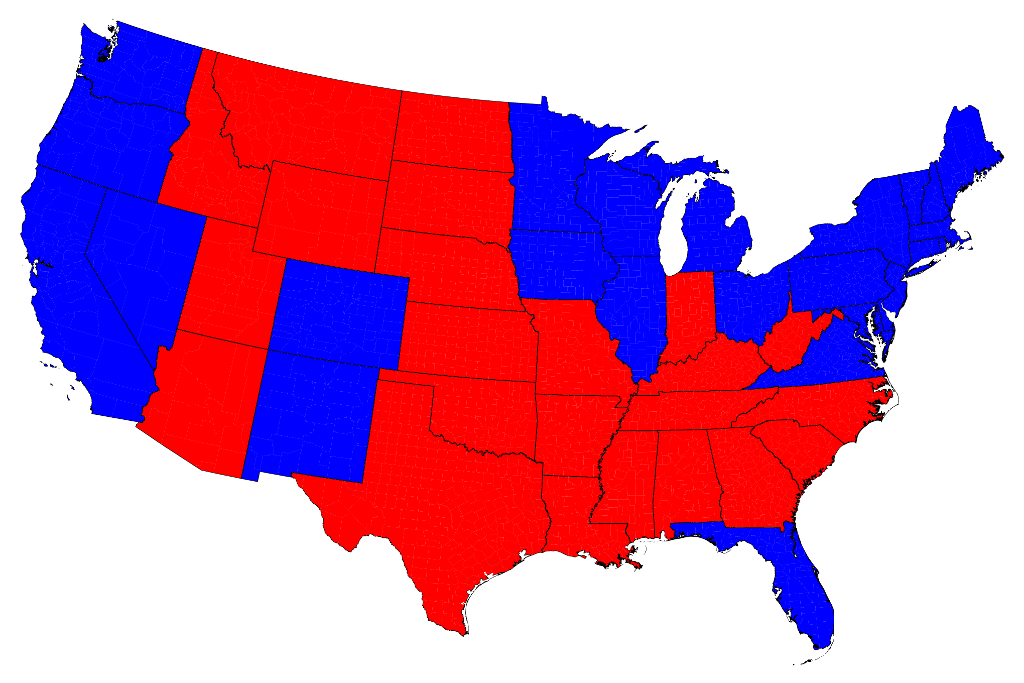
Many can already see how partitioning based off of this geopolitical set up wouldn't work. The progressive leaning states would never allow it. They would effectively be torn asunder and as I have mentioned before, the red states would control the most important river, essentially the fountainhead of what drives American global power, on the continent. There is absolutely no way the current government would allow this to happen, and it is a pipe dream to think otherwise. War would result, and it would be very bloody, the northern states refused to allow the southern states to cede, because of the importance of the Mississippi, back in 1861 and I very much doubt that they would allow it to happen in the 21st century. But this map alone is misleading. This map is more accurate.

As we can see there are liberal and conservative leanings throughout the country, and if we were to partition the states off what could we assume would happen? The answer is massive migration. Even if a single percent of the American population decided that they would travel to the new nation that better fit their ideological life view, it would mean millions of Americans migrating all over the country. This is the most important thing people forget when they talk about secession. In 1860 the divide was very much geographical, north versus south, in 2012 it is not so the geography of the states were the divide lies, our electoral map distorts the reality of the situation, it is an urban versus rural divide.
What does this mean? It means that simply lopping off states to make new nations will not work, as it does not reflect the reality of the situation on the ground. It isn't Midwestern states versus the coastal states, it is the rural folk against the urban folk, with the suburbanites in between. The facts presented should make one thing very clear, peaceful partitioning is almost an impossibly. Even if local governments don't fight because of racial demographics, geographic borders and location, or because of resources, which the red states have most of that is easily accessible (see gas production below), there will be the violence that comes with massive migrations of people from one place to another.

And what if there was a successful secession movement, or partitioning, of what is now the United States? After fighting off the US, or some other state military assuming absolute dissolution of the Union, what happens afterwards? History has an abundance of examples of the aftermath of rebellions and secession movements, and the result isn't pretty. More often than not the government that replaces the one overthrown is usually worse. One also only need look at Russia and see that it is not always the popular ideology that wins out in the political arena. The Marxists didn't take over Russia because they were he most popular, or inherently true, ideology with the revolutionaries, no, they won because they were the most organized and ruthless. When you seek change at the end of a rifle, it should come as no surprised that those who are most predisposed of using violence to achieve their ends are the ones most likely to rule.
Lastly, let us assume that, not only do we have a successful partitioning or secession, and we are able to establish a new government that followed constitutional ideals, what happens next? Is that the end of the political problems in America? Progressive states would continue their Utopian economic slide while conservative states, with their new adherence to the constitution, thrive? Doubtful. What assumes that the new conservative leaning nation wouldn't be inundated with a flood of progressive leaving their economically declining nations, which is exactly what they are doing now, to economically prosperous ones? Moreover what is to assume that our descendants will not travel upon the same path we have? It is a mistake to assume that just because a nation is smaller that the second time around would be any different.
And that is the thing most people need to be cognizant of, that things wouldn't be any different. The same conditions that caused America's gradual acceptance of statist principals would still be there. Just because you segregate the liberal Americans, who have come to accept the ideology of statism, from conservative Americans, who are only slightly less likely to want the state run their lives, doesn't mean you have solved the problem, much like the Roman empire partitioning itself into two empires, you have only bought some time.
If America as it is now cannot survive, united and free, then it is an absolute fantasy to assume that a new attempt will work. Empirical evidence will have been presented that shows a free society can only exist for a short time before it self destructs. If the American experiment fails, and if the nation falls apart or succumbs to statism, then we should just give up on the idea of ever achieving liberty, because it won't exist for more than a few generations. Partitioning off parts of the country would only delay the inevitable. Either America stands, or freedom falls, take your pick.